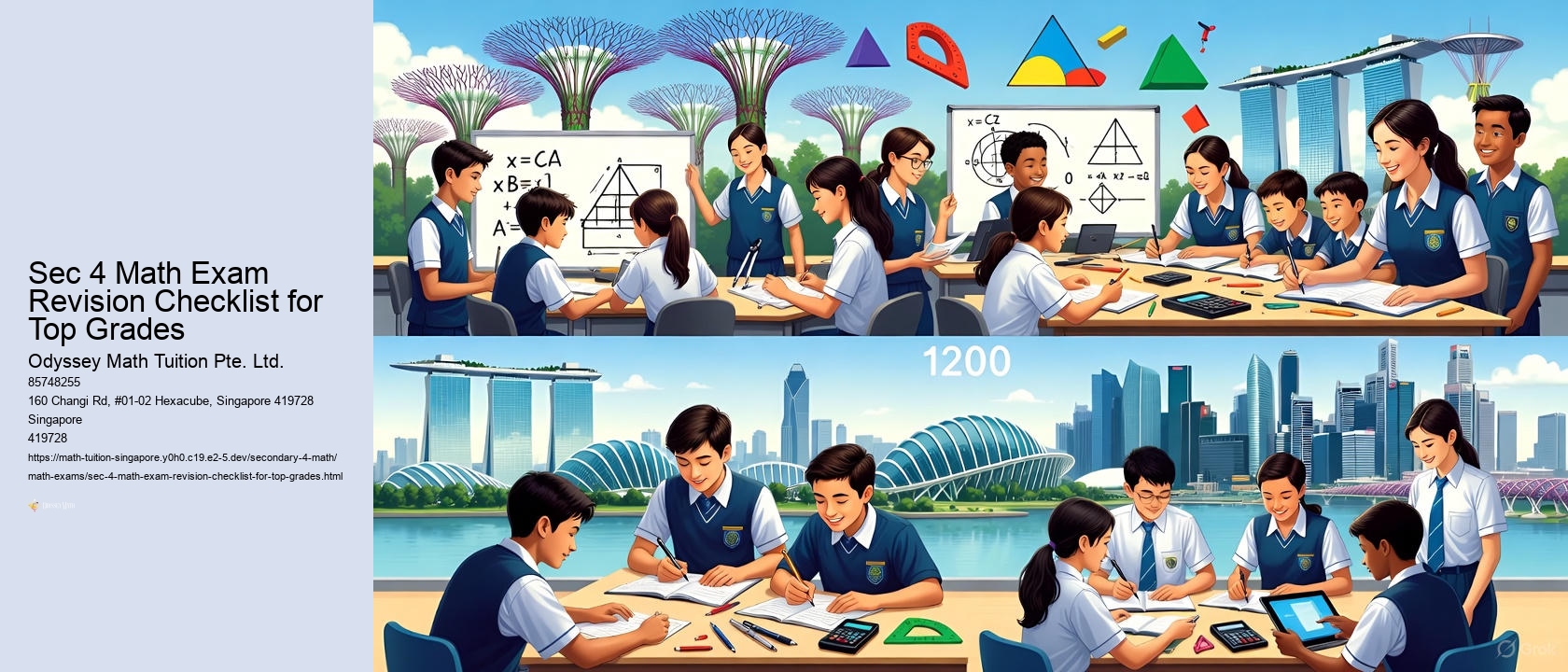
Alright, lah! Let's talk about how to really conquer that Sec 4 Math exam, yeah? Not just pass, but own it. We know, as Singaporean parents, we want the best for our kids, and that includes acing their O-Levels. Math is not just another subject; it's the foundation for everything – from engineering to finance, and even coding with all this AI popping up! So, listen up, students and parents, this is the real deal on how to excel in Singapore Secondary 4 Math!
Okay, imagine your Sec 4 Math exam is like climbing Bukit Timah Hill. You wouldn't just chiong up without a plan, right? Same thing here. This checklist is your map to the summit!
Okay, now let's talk about the gahmen (government) secrets – the common pitfalls that students fall into. Knowing these can help you avoid them!
This is a killer for many students. Here are some tips to minimize them:
Did you know that the word "algebra" comes from the Arabic word "al-jabr," which means "the reunion of broken parts"? It was used to describe the process of solving equations by rearranging and combining terms. So, in a way, algebra is all about putting things back together!
Singapore's education system consistently ranks among the top in the world, and mathematics is a key focus. The emphasis on problem-solving skills and critical thinking in math education prepares students for success in a wide range of fields.
Remember, kiasu (fear of losing out) is a Singaporean trait, but don't let it overwhelm you. Preparation and a positive attitude are your best weapons. Sec 4 Math Exam Study Checklist: Singapore Edition . In today's demanding educational landscape, many parents in Singapore are hunting for effective methods to improve their children's grasp of mathematical principles, from basic arithmetic to advanced problem-solving. Building a strong foundation early on can greatly boost confidence and academic performance, aiding students tackle school exams and real-world applications with ease. For those considering options like secondary 4 math it's essential to prioritize on programs that highlight personalized learning and experienced support. This approach not only tackles individual weaknesses but also cultivates a love for the subject, leading to long-term success in STEM-related fields and beyond.. Jia you! (Add oil! - Keep going!)
Alright, parents and students, listen up! In Singapore's bilingual education system, where fluency in Chinese is essential for academic excellence, parents frequently seek methods to help their children grasp the language's intricacies, from word bank and interpretation to composition crafting and speaking proficiencies. With exams like the PSLE and O-Levels imposing high standards, early assistance can avert frequent obstacles such as subpar grammar or restricted exposure to cultural contexts that enrich education. For families aiming to elevate results, investigating Singapore Chinese tuition materials provides knowledge into organized programs that sync with the MOE syllabus and nurture bilingual confidence. This focused guidance not only strengthens exam preparedness but also instills a more profound appreciation for the language, unlocking opportunities to traditional roots and future career edges in a multicultural community.. Sec 4 Math is no joke, ah? It's like the foundation of your academic future, and in a world increasingly run by AI, math skills are extra important. Think of it this way: mastering algebra isn't just about acing your exams; it's about future-proofing your child's career. Singapore's competitive landscape demands the best, and that starts with a solid grasp of mathematical concepts. In a digital time where ongoing education is essential for career progress and personal growth, prestigious institutions internationally are breaking down obstacles by providing a abundance of free online courses that cover diverse disciplines from digital studies and management to social sciences and wellness fields. These efforts allow students of all backgrounds to tap into top-notch lessons, assignments, and materials without the financial burden of standard admission, commonly through systems that provide convenient pacing and dynamic elements. Uncovering online universities free courses provides opportunities to prestigious schools' insights, empowering proactive individuals to upskill at no charge and secure credentials that boost profiles. By making elite learning openly obtainable online, such initiatives encourage international equity, empower marginalized populations, and foster creativity, demonstrating that excellent information is more and more merely a step away for everyone with web availability.. So, let's dive into how to excel in Singapore Secondary 4 Math, especially when it comes to algebra – the area where many students "lose" marks unnecessarily.
This isn't just any checklist; it's your secret weapon to conquer those algebraic demons! These tuition tips are designed to help your child navigate the treacherous waters of Sec 4 Math with confidence.
Master the Fundamentals: Before tackling complex problems, ensure a rock-solid understanding of basic algebraic principles. This includes:
Conquer Algebraic Manipulation: This is where the real fun begins (or the real stress, if you're not prepared!).
Ace Equation Solving: This is the bread and butter of algebra.
Let's be real, everyone makes mistakes. But the key is to learn from them. Here are some common pitfalls in Sec 4 Math, along with strategies to avoid them:
Careless Errors in Expansion and Factorization:
Mistake: Forgetting to distribute the negative sign when expanding expressions like -(x + 2).
Solution: Always double-check the signs. Use brackets carefully to avoid sign errors.
Mistake: Incorrectly factoring quadratic expressions.
Solution: Practice, practice, practice! Use the "AC method" or trial and error to find the correct factors.

Incorrect Application of Formulas:
Misunderstanding Word Problems:
Subtopic: Error Correction Strategies
Practice Regularly: The more you practice, the more familiar you'll become with different types of problems and the less likely you are to make mistakes.
Fun Fact: Did you know that algebra has roots in ancient civilizations like Egypt and Babylon? They used algebraic techniques to solve practical problems related to land surveying and trade.
Want to go beyond just passing and truly excel? Here's how:
Get Enough Sleep: A well-rested brain is a sharp brain. Make sure you're getting enough sleep in the days leading up to the exam.
Interesting Fact: The word "algebra" comes from the Arabic word "al-jabr," which means "reunion of broken parts." This refers to the process of rearranging and simplifying equations to solve for unknown variables.
In Singapore, we're all about being forward-thinking. With AI becoming increasingly prevalent, a strong foundation in mathematics is more crucial than ever. AI algorithms rely heavily on mathematical concepts like linear algebra, calculus, and statistics. By mastering these concepts, your child will be well-equipped to thrive in the future job market. It's not just about getting good grades; it's about preparing for a world where mathematical literacy is a must-have skill.
So, there you have it! Follow these tips, and your child will be well on their way to acing their Sec 4 Math exams and building a bright future. Jiayou! (Add Oil!)
Many students find circle theorems challenging, often misapplying or forgetting the correct angle properties. A common mistake is assuming angles are equal when they are not subtended by the same arc or segment. To how to excel in singapore secondary 4 math, it's crucial to meticulously draw diagrams and clearly label all angles. Practice identifying the relevant theorems for each problem, such as the angle at the centre being twice the angle at the circumference, or angles in the same segment being equal. Remember, ah, "see clearly, solve accurately," as my old math teacher used to say!
Trigonometric identities are the bedrock of many trigonometry problems, and overlooking or misremembering them can lead to significant errors. A frequent pitfall is incorrectly applying identities like sin²θ + cos²θ = 1 or tan θ = sin θ / cos θ. To avoid this, create a cheat sheet with all the essential identities and practice using them in various contexts. In Singapore's vibrant education environment, where learners deal with considerable stress to succeed in math from early to higher stages, discovering a learning center that integrates proficiency with true passion can make a huge impact in fostering a passion for the discipline. Passionate educators who go beyond rote study to inspire critical problem-solving and resolution competencies are uncommon, yet they are vital for aiding learners overcome challenges in areas like algebra, calculus, and statistics. For guardians hunting for similar dedicated assistance, PSLE math tuition shine as a beacon of dedication, driven by teachers who are strongly invested in each pupil's progress. This steadfast passion converts into tailored lesson approaches that adapt to individual demands, culminating in improved scores and a enduring fondness for mathematics that spans into future academic and career pursuits.. Understanding the derivation of these identities can also help in remembering them more effectively, making them easier to recall during the Sec 4 Math exam revision. Don't just memorise; understand!
Incorrectly applying angle properties, especially in complex geometric figures, is another prevalent error. This includes misunderstanding alternate angles, corresponding angles, and interior angles in parallel lines. To improve, focus on clearly identifying parallel lines and transversals within the diagram. Practicing with a variety of problems that involve different angle properties is key to mastering this concept. Remember to always state the reasons for your angle calculations during your Sec 4 Math exam revision, showing your workings clearly.
Spatial visualisation is crucial for solving 3D geometry problems, and a lack of this skill can lead to misinterpretations of the problem setup. Many students struggle with visualising shapes and angles in three dimensions, leading to incorrect calculations of surface areas and volumes. To enhance spatial visualisation, practice drawing diagrams from different perspectives and use physical models to understand the relationships between different parts of the shape. Consistent practice is the key to mastering this skill and how to excel in singapore secondary 4 math.
Misapplying trigonometric ratios (sine, cosine, tangent) is a common mistake, especially when dealing with angles of elevation and depression. A frequent error is using the wrong ratio for a given angle or failing to identify the correct sides of the triangle (opposite, adjacent, hypotenuse). To avoid this, always draw a clear diagram and label the sides and angles correctly. Practice applying SOH CAH TOA in different scenarios and remember to double-check your calculations. With AI technologies becoming more prevalent, a strong foundation in trigonometry is essential for future success.
In the Lion City's challenging education environment, where English acts as the key vehicle of instruction and assumes a central position in national exams, parents are keen to help their youngsters overcome frequent obstacles like grammar affected by Singlish, vocabulary gaps, and issues in understanding or writing crafting. Building strong basic abilities from primary levels can substantially elevate assurance in handling PSLE parts such as scenario-based writing and verbal interaction, while secondary students profit from targeted training in book-based examination and persuasive essays for O-Levels. For those looking for effective strategies, investigating singapore math tuition agencies delivers helpful perspectives into curricula that sync with the MOE syllabus and emphasize engaging learning. This extra support not only sharpens assessment techniques through mock trials and reviews but also encourages domestic routines like everyday literature plus conversations to nurture long-term tongue expertise and scholastic success..Eh, parents and Sec 4 students! Feeling the pressure cooker heat as exams loom? We know the feeling! In Singapore, acing those Math exams – especially in Secondary 4 – can feel like the ultimate kiasu (afraid to lose) battle. But don't worry, lah! We're here to arm you with a revision checklist to help your child (or yourself!) conquer those complex equations and emerge victorious.
Why all the fuss about Math, you ask? Well, besides being a core subject, a strong foundation in mathematics is absolutely crucial for future success. With AI and technology becoming increasingly prevalent, mathematical concepts are no longer just abstract theories; they're the building blocks of innovation. Think data science, engineering, finance – all fields where mathematical prowess is highly prized. Confirm plus chop (absolutely certain) that doing well in Sec 4 Math sets the stage for a brighter future!
So, how to excel in Singapore Secondary 4 Math? This isn't just about memorising formulas; it's about understanding the concepts, applying them effectively, and avoiding those pesky mistakes that can cost you marks. Here’s your battle plan:
Fun Fact: Did you know that the concept of zero, so crucial in mathematics, wasn't always around? It took centuries for mathematicians to fully grasp its significance and incorporate it into our number system!
Knowing what *not* to do is just as important as knowing what to do! Here's a rundown of common pitfalls to avoid:
This is super important, especially for those method marks! Examiners want to see *how* you arrived at your answer, not just the answer itself. Here's how to do it right:
Interesting Fact: The word "algebra" comes from the Arabic word "al-jabr," meaning "the reunion of broken parts." This refers to the process of rearranging equations to solve for an unknown variable.
Let's dive into one of the trickier areas: Calculus. This section explains derivative applications and integration techniques, highlighting typical errors in differentiation and integration. It helps students build a strong foundation. Focus on how to correctly write down the steps, drawing exclusively from verifiable facts sourced from reputable references.
Derivative Applications:
Integration Techniques:
Typical Errors in Differentiation and Integration:
By understanding these concepts and avoiding these common mistakes, you can build a strong foundation in calculus and improve your performance in the Sec 4 Math exam.
History: Calculus, as we know it, was largely developed independently by Isaac Newton and Gottfried Wilhelm Leibniz in the 17th century. Their work revolutionized mathematics and laid the foundation for modern science and engineering.
So there you have it! With this revision checklist and a healthy dose of hard work, your child (or you!) can chiong (rush) towards those top grades in Sec 4 Math. Remember, it's not just about the grades; it's about building a solid foundation for future success in a world increasingly driven by mathematics and technology. Good luck, and remember to stay calm and jia you (add oil/press on)!
Solidify your understanding of core concepts like algebra, geometry, and trigonometry. Focus on grasping the underlying principles rather than rote memorization. Practice applying these concepts to a variety of problem types to build confidence and proficiency.
Allocate sufficient time for each section and question type during the exam. Practice solving problems under timed conditions to improve speed and accuracy. Learn to prioritize questions based on difficulty and potential marks to optimize your overall score.
Identify recurring errors in past assessments and practice questions. Analyze the root causes of these mistakes, whether they stem from conceptual misunderstandings or careless calculations. Develop strategies to prevent similar errors from happening again during the actual exam.
Right, parents and students, let's talk about probability and statistics in your Sec 4 Math exams. Don't play play, ah! In this AI age, mastering mathematics is super important, not just for scoring well, but also for your kids' future careers. We're talking about building a solid foundation for success, confirm plus chop! Think data science, engineering, finance – all heavily reliant on a strong understanding of mathematical concepts. So, let's dive into how to really conquer this topic and avoid those kanchiong moments during the exam. This is all about how to excel in Singapore Secondary 4 Math, so listen up!
This section covers probability distributions, statistical measures, and how to chiong through the interpretation. The key is understanding the conditions for probability and interpreting the data. It's also important to understand the underlying assumptions. We'll show you how to avoid common errors in calculation and analysis.
Did you know that the concept of probability has roots in games of chance? Mathematicians like Gerolamo Cardano and Pierre de Fermat started exploring probability while trying to understand the odds in gambling! Now, that's an interesting way to start a mathematical field!
Let's be real, lah. Everyone makes mistakes. But the key is to learn from them! Here are some common pitfalls to avoid:
Here's something to chew on: The normal distribution, also known as the Gaussian distribution, is one of the most important distributions in statistics. It's used to model a wide variety of phenomena, from heights and weights to exam scores. It's so important that it's sometimes called the "bell curve" because of its distinctive shape!

The development of statistics has been influenced by many brilliant minds, including Ronald Fisher, Karl Pearson, and Florence Nightingale (yes, the nurse!). They developed statistical methods that are still used today in fields like medicine, agriculture, and social science.
Here are some tips for Singapore parents and students on how to excel in Singapore Secondary 4 Math:
Remember, lah, mathematics is not just about numbers and formulas. It's about problem-solving, critical thinking, and logical reasoning. These are skills that will serve you well in any field. So, embrace the challenge, chiong hard, and jiayou!
Sec 4 Math. Siao liao, exams are just around the corner! As Singaporean parents, we all want our kids to kiasu their way to top grades, right? But let's be real, Secondary 4 Math can be a real killer. It's not just about memorizing formulas; it's about understanding the concepts and applying them like a pro. And in this age of AI, where algorithms are king, a strong foundation in math is more crucial than ever for your child's future success. Want to know how to excel in Singapore Secondary 4 Math? Read on, parents and students!
This isn't just another article filled with generic advice. We're diving deep into practical, actionable strategies that will help your child not only survive but thrive in their Sec 4 Math exams. Think of it as a survival guide, Singapore-style!
Alright, let's get down to brass tacks. This checklist is your roadmap to acing that Math exam. Tick them off one by one, and watch your child's confidence (and grades!) soar.
Before tackling the tough stuff, make sure your child has a solid grasp of the basics. This means revisiting key concepts from previous years. Think of it as building a strong foundation for a skyscraper – you can't build high without a solid base!
Go through the Sec 4 Math syllabus point by point. Identify areas where your child feels less confident and dedicate extra time to them. Knowledge is power, and knowing what to expect is half the battle won.
There's no substitute for practice! Work through a variety of questions from different sources – textbooks, past year papers, and assessment books. The more they practice, the more comfortable they'll become with different question types.
Don't be afraid to ask for help! If your child is struggling with a particular topic, encourage them to seek guidance from their teachers, tutors, or classmates. Sometimes, a fresh perspective is all they need to break through a mental block.
Knowing the content is only half the battle. Your child also needs to master exam techniques to maximize their marks. This includes time management, question selection, and presentation skills.
Fun Fact: Did you know that the word "mathematics" comes from the Greek word "máthēma," which means "knowledge, study, learning"? So, by studying math, your child is essentially unlocking the door to a world of knowledge!
Okay, parents, let's talk strategies. These are the secret weapons that will give your child the edge they need to conquer that Math exam.
Interesting Fact: The Singapore education system is consistently ranked among the best in the world, thanks to its rigorous curriculum and emphasis on mathematics and science. Your child is already on the right track!
Time is of the essence during the exam. Here's how to help your child allocate their time effectively and tackle different question types.
Alright, let's talk about maximizing those marks! These are the strategies that can help your child squeeze every last point out of the exam.
Exam stress is a real thing, especially in Singapore! Here's how to help your child manage their stress levels and stay calm and focused during the exam.
Time is precious during the exam. Here's how to help your child prioritize which questions to attempt first.
Knowing the common pitfalls can help your child avoid them. Here's a rundown of common mistakes students make in Sec 4 Math exams.
Alright, parents and Sec 4 students, listen up! Feeling the pressure cooker heat of O-Levels? Don't say bo jio – this section is all about how to chiong effectively for your Math exams. We're talking about smart studying, not just studying hard. Think of it as leveling up your Math skills, one resource at a time. Let's dive in!
Past year papers (PYP) are your best friends, confirm plus chop! They're like peeking into the future, giving you a sneak peek at the exam format, question types, and difficulty level. But don't just blindly do them. Here's the secret sauce:
* **Treat it like the real deal:** Set a timer, no distractions, and simulate exam conditions. This helps build exam stamina and reduces anxiety on the actual day. * **Analyse, analyse, analyse:** After attempting, meticulously review your answers. Identify your weak areas and understand the marking scheme. Even if you got the answer right, check the suggested solution to see if you can improve your method. * **Spot the trends:** Are certain topics consistently appearing? Focus your revision on those areas. * **Don't just do, understand:** If you can't solve a question, don't just look at the answer. Try to understand the underlying concepts and principles. Then, try similar questions to reinforce your learning.
Fun Fact: Did you know that the Singapore Examinations and Assessment Board (SEAB) often reuses question formats from previous years? Spotting these patterns can give you a serious advantage!
Your textbooks aren't just doorstops! They are a treasure trove of knowledge.
* **Revisit key concepts:** Go back to the basics. Ensure you have a solid understanding of the fundamental principles. Don't gloss over anything, even if it seems simple. * **Work through examples:** Textbooks are filled with worked examples. Redo them without looking at the solutions. This will test your understanding and problem-solving skills. * **Review your notes:** Your notes are a personalized summary of what you've learned. They're a great way to refresh your memory and identify areas where you need more clarification.
In this day and age, you've got a whole universe of learning resources at your fingertips! But use them wisely, hor?
* **Educational Websites:** Websites like Khan Academy, and YouTube channels offer video tutorials and practice questions on various Math topics. * **Practice Questions:** Many websites offer practice questions with detailed solutions. Use these to test your understanding and identify areas where you need more practice. * **Online Forums:** Engage with other students and teachers in online forums. Ask questions, share tips, and learn from others.
Interesting Fact: With the rise of AI, many online platforms now offer personalized learning experiences tailored to your specific needs and learning style. This can be a game-changer for your Math revision!
Sometimes, you just need that extra help to clarify concepts and get personalized guidance. That's where tuition comes in. But choose wisely!
* **Find a qualified tutor:** Look for a tutor with a strong Math background and experience teaching Sec 4 Math. Ask for references and check their credentials. * **Communicate your needs:** Be clear about your learning goals and areas where you need help. The more specific you are, the better your tutor can assist you. * **Active participation:** Don't just sit back and listen. Ask questions, participate in discussions, and actively engage in the learning process. * **Don't be shy to ask your school teachers for help:** Your school teachers are always there to help you. So don't be shy to ask them questions or seek clarification.
Studying with friends can be a fun and effective way to learn. But make sure it's productive, not just a social gathering!
* **Form a study group:** Gather a few friends who are also serious about their Math studies. * **Divide and conquer:** Assign different topics to each member and have them teach it to the group. This forces you to understand the material thoroughly. * **Solve problems together:** Work through challenging problems as a group. Discuss different approaches and learn from each other's mistakes. * **Stay focused:** Set clear goals for each study session and stick to them. Avoid distractions and stay on task.
Knowing what *not* to do is just as important as knowing what to do! Here are some common pitfalls to avoid. This is how to excel in singapore secondary 4 math
* **Careless Mistakes:** Silly errors like misreading the question, copying the wrong numbers, or making arithmetic mistakes can cost you valuable marks. Double-check your work carefully. * **Misunderstanding Concepts:** A superficial understanding of concepts can lead to mistakes when faced with unfamiliar questions. Make sure you truly understand the underlying principles. * **Poor Time Management:** Spending too much time on difficult questions can leave you with insufficient time to complete the rest of the paper. Practice time management techniques. * **Not Showing Working:** Even if you get the answer right, you may not get full marks if you don't show your working. Always show your steps clearly and logically. * **Forgetting Formulas:** Memorize key formulas and know when and how to apply them. Create a formula sheet for quick reference.
Subtopic: How to Avoid Careless Mistakes
Remember, parents and students, Math is not just about memorizing formulas. It's about developing critical thinking and problem-solving skills. And in a world increasingly driven by AI, these skills are more important than ever. In Singapore's demanding education framework, where scholastic achievement is essential, tuition generally refers to private supplementary sessions that offer specific support in addition to school programs, aiding learners grasp subjects and gear up for major exams like PSLE, O-Levels, and A-Levels during intense pressure. This private education industry has grown into a lucrative market, fueled by parents' expenditures in tailored instruction to close knowledge deficiencies and improve scores, although it often adds stress on developing learners. As artificial intelligence emerges as a game-changer, delving into innovative online tuition approaches reveals how AI-powered tools are personalizing learning processes worldwide, providing adaptive mentoring that exceeds standard techniques in effectiveness and involvement while resolving worldwide learning inequalities. In the city-state specifically, AI is transforming the traditional supplementary education system by enabling cost-effective , flexible applications that correspond with countrywide curricula, potentially cutting fees for households and improving outcomes through analytics-based analysis, even as principled issues like heavy reliance on digital tools are debated.. So, jia you! You can do it!
Focus on Algebra (Quadratic Equations, Surds, Indices), Geometry (Congruence, Similarity, Trigonometry), and Statistics (Data Analysis, Probability). These form the core of the Sec 4 Math exam.
Allocate time proportionally to the marks for each question. Start with questions youre confident in, and dont spend too long on any single question. If stuck, move on and return later.
Read the problem carefully, identify key information, define variables, form equations, and solve. Practice translating word problems into mathematical expressions.
Understanding the concepts is crucial. While memorizing formulas is helpful, knowing how and why they work allows you to apply them in different contexts and solve problems more effectively.
Common mistakes include careless calculation errors, incorrect application of formulas, and misinterpreting word problems. Double-check your work, understand the formulas thoroughly, and practice problem-solving.
Treat past year papers as mock exams. Solve them under timed conditions, identify your weaknesses, and focus your revision on those areas. Analyze the marking scheme to understand how marks are awarded.
Consider using textbooks, online resources (Khan Academy, YouTube tutorials), and seeking help from teachers or tutors. Practice papers and assessment books are also valuable tools.