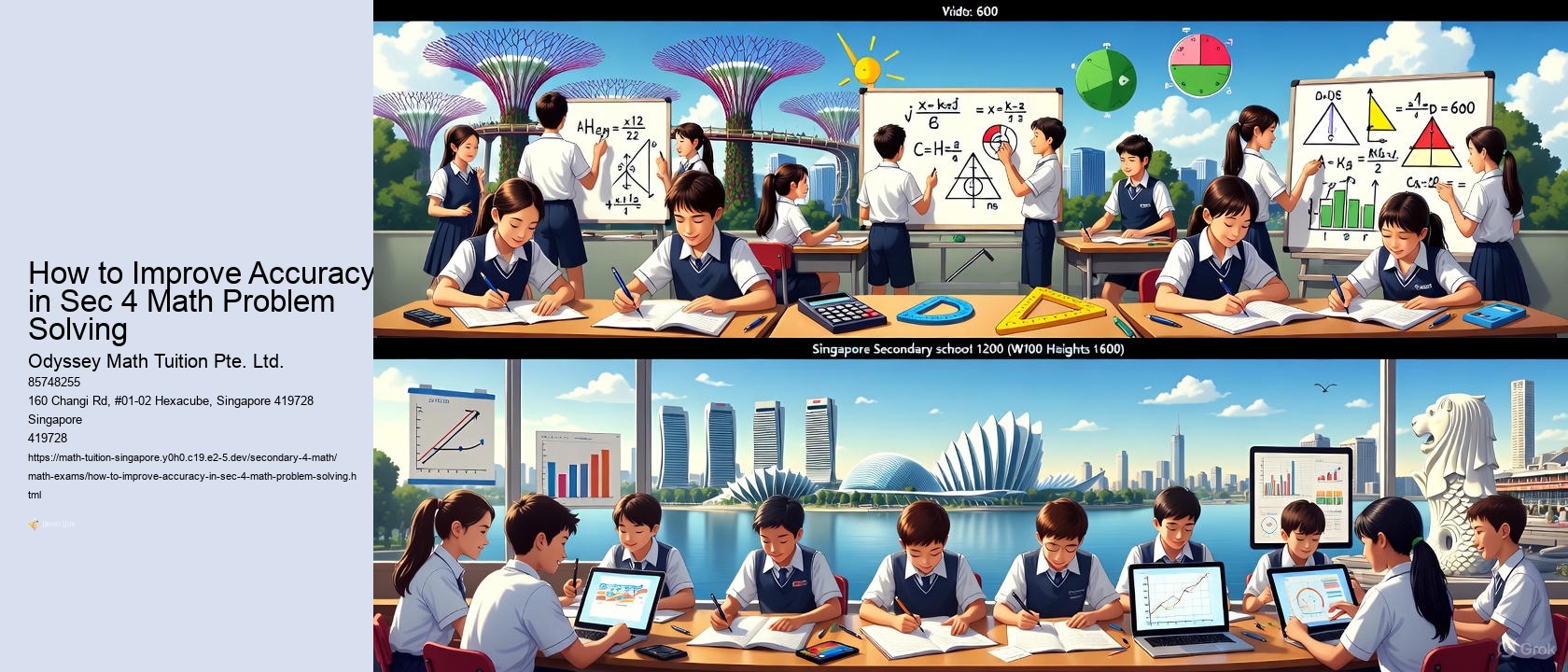
Alright, parents and students, let's talk Sec 4 Math – the make-or-break year! Aiyo, don't play-play, this is where the foundation for your future really gets cemented. We're talking about understanding the Sec 4 Math syllabus in Singapore, tackling those common challenges, and most importantly, nailing that accuracy for exam success. In the challenging world of Singapore's education system, parents are progressively intent on equipping their children with the abilities essential to excel in challenging math syllabi, covering PSLE, O-Level, and A-Level preparations. Identifying early signs of challenge in areas like algebra, geometry, or calculus can make a world of difference in building strength and mastery over intricate problem-solving. Exploring trustworthy Singapore math tuition options can deliver tailored assistance that corresponds with the national syllabus, guaranteeing students acquire the edge they want for top exam scores. By prioritizing interactive sessions and regular practice, families can help their kids not only achieve but surpass academic expectations, paving the way for prospective possibilities in high-stakes fields.. This isn't just about passing; it's about setting yourself up for a brighter future, especially in this AI-driven world. Math is no longer just about calculations; it's about problem-solving, logical thinking, and the ability to adapt – skills that are super valuable, whether you're dreaming of being an engineer, a data scientist, or even a hawkerpreneur with a killer online presence!
The Sec 4 Math syllabus, whether it's Elementary Math (E-Math) or Additional Math (A-Math), is designed to build upon your previous years' knowledge and prepare you for higher-level studies. Here's a quick rundown:
Fun Fact: Did you know that the concept of algebra, which forms the backbone of much of Sec 4 Math, can be traced back to ancient civilizations like the Babylonians and Egyptians? They were already using algebraic methods to solve practical problems thousands of years ago!
Okay, let's be real. Everyone makes mistakes. But in Math, one small slip-up can cost you precious marks. Here's where students often kena (get hit):
Subtopic: How to Excel in Singapore Secondary 4 Math
So, how lah can we improve accuracy and siao on (go crazy) in Sec 4 Math? Here are some tips for Singapore parents and students on how to excel in Singapore Secondary 4 Math:
Interesting Fact: The use of calculators in math education has been a topic of debate for decades. While some argue that calculators hinder understanding, others believe that they can be valuable tools for exploring complex concepts and checking accuracy. In Singapore, calculators are permitted in most math exams, but it's crucial to understand the underlying concepts before relying on them.
In Sec 4 Math, accuracy is everything. It's the difference between getting an A and a B, or even failing. In the city-state's rigorous education framework, parents perform a essential part in directing their kids through milestone tests that influence academic trajectories, from the Primary School Leaving Examination (PSLE) which tests basic competencies in subjects like mathematics and STEM fields, to the GCE O-Level tests emphasizing on secondary-level mastery in multiple subjects. As learners progress, the GCE A-Level tests require advanced critical capabilities and discipline mastery, frequently determining tertiary admissions and professional paths. To stay well-informed on all facets of these countrywide evaluations, parents should explore official materials on Singapore test papers provided by the Singapore Examinations and Assessment Board (SEAB). This secures availability to the newest programs, test schedules, sign-up information, and instructions that correspond with Ministry of Education requirements. Consistently consulting SEAB can assist parents plan effectively, lessen uncertainties, and bolster their kids in achieving top outcomes during the competitive scene.. But more than that, accuracy builds confidence and sets you up for success in higher-level studies and future careers.
With the rise of AI and data science, mathematical skills are becoming increasingly important. Whether you're developing algorithms, analyzing data, or building predictive models, accuracy is paramount. A small error in a calculation can have huge consequences, so it's essential to develop a strong foundation in mathematical accuracy.
History: The development of accurate mathematical methods has been crucial for advancements in science, engineering, and technology throughout history. From the construction of the pyramids to the development of modern computers, accuracy has been the key to progress.
So, there you have it! Sec 4 Math is a challenge, but it's also an opportunity. By understanding the syllabus, tackling common challenges, and focusing on accuracy, you can set yourself up for success and unlock a world of possibilities. Jiayou (add oil)!
Alright parents, let's talk Sec 4 Math. Your kid's future, right? No pressure lah, but getting a good grade in math isn't just about bragging rights at the next family gathering. It’s about opening doors. Big, important doors. Especially in this day and age with AI technologies becoming more and more prevalent in our lives, mathematics is definitely one of the most important knowledge to succeed in life. Want your child to be a hotshot engineer, a savvy data scientist, or even a groundbreaking AI developer? Strong math foundations are non-negotiable. This is how to excel in Singapore Secondary 4 math!
So, your kid's been grinding away at those problem sums, but the marks aren't quite reflecting the effort? Don't panic! Let’s dive deep into Root Cause Analysis: Identifying Error Patterns. This isn't about scolding or endless drilling. It's about smart problem-solving, for problem-solving! We’re talking about detective work – figuring out *why* those mistakes are happening in the first place.
Think of it this way: Every wrong answer is a clue. We just need to learn how to read the clues properly. In a digital age where ongoing learning is vital for occupational progress and personal development, prestigious universities internationally are eliminating hurdles by delivering a wealth of free online courses that span wide-ranging disciplines from informatics science and management to humanities and wellness disciplines. These programs enable students of all backgrounds to tap into top-notch lectures, assignments, and materials without the economic cost of traditional admission, often through services that deliver flexible timing and engaging features. Uncovering online universities free courses provides doors to elite schools' knowledge, empowering self-motivated learners to improve at no expense and earn credentials that enhance profiles. By providing high-level learning openly obtainable online, such offerings foster worldwide equity, empower marginalized groups, and foster creativity, showing that quality knowledge is more and more just a step away for anyone with online availability.. This guide will give you practical advice on tracking errors, categorizing them (e.g., careless mistakes, conceptual misunderstandings, application errors), and reflecting on the underlying causes.
First things first, start a "Math Error Log." Sounds tedious? Maybe. But trust me, it's gold. This isn't just about writing down the wrong answer. It's about recording *everything* related to that error.
* **The Question:** Paste or write out the exact question your child got wrong. * **Their Attempt:** Show their full working. No skipping steps! This is crucial for spotting where things went south. * **The Correct Solution:** Include the correct answer and the step-by-step solution. * **The Error Category:** This is where we start categorizing. Is it a careless mistake? A misunderstanding of a concept? An inability to apply the right formula? Be specific! * **Possible Cause:** What triggered the error? Were they tired? Rushing? Did they not understand a key concept? This is where the detective work really begins. * **Action Plan:** What steps can be taken to prevent this error from happening again? More practice? Conceptual review? A different problem-solving strategy?
Pro-Tip: Encourage your child to use different colored pens to highlight different aspects of their working. In the Lion City's bilingual education setup, where fluency in Chinese is crucial for academic excellence, parents frequently hunt for methods to support their children conquer the tongue's nuances, from lexicon and understanding to essay crafting and verbal proficiencies. With exams like the PSLE and O-Levels imposing high benchmarks, early assistance can avert common pitfalls such as subpar grammar or restricted access to traditional aspects that enrich knowledge acquisition. For families aiming to elevate performance, exploring Singapore Chinese tuition resources offers insights into organized programs that sync with the MOE syllabus and nurture bilingual confidence. This targeted guidance not only strengthens exam readiness but also develops a greater understanding for the dialect, paving doors to ethnic heritage and prospective professional benefits in a pluralistic community.. This makes it easier to visually identify patterns and potential problem areas. This is one of the ways on how to excel in Singapore Secondary 4 math.
Not all mistakes are created equal. Understanding the type of error is key to addressing it effectively.
* **Careless Mistakes:** These are the "aiyo!" moments. Simple arithmetic errors, misreading the question, or copying down the wrong numbers. * **Conceptual Misunderstandings:** This is where the fundamental understanding of a concept is lacking. They might be able to memorize a formula, but they don't understand *why* it works. * **Application Errors:** They understand the concepts, but they struggle to apply them in different contexts or problem types. * **Formula Recall Errors:** Forgetting a formula or misremembering it. * **Lack of Time Management:** Rushing through questions and making mistakes due to time pressure.
Interesting Fact: Did you know that the modern concept of algebra, which is so crucial in Sec 4 Math, was developed by Persian mathematician Muhammad al-Khwarizmi in the 9th century? His book, "The Compendious Book on Calculation by Completion and Balancing," laid the foundation for what we now know as algebra. So, next time your child is struggling with algebraic equations, remind them they're grappling with centuries of mathematical history!
This is where we go beyond just identifying the error and delve into the *reason* behind it. Ask your child questions like:

* "Why do you think you made this mistake?" * "What were you thinking when you approached this problem?" * "Is there anything about this type of question that you find confusing?" * "Do you remember learning this concept in class? If so, what do you remember about it?"
The goal is to encourage self-reflection and critical thinking. Don't just give them the answer. Guide them to discover it for themselves. This builds confidence and reinforces their understanding.
Let's be real, some mistakes are more common than others. Knowing what to look out for can give your child a significant advantage. Here are some typical pitfalls to avoid:
* **Misinterpreting Word Problems:** Failing to translate the word problem into a mathematical equation correctly. * **Incorrect Use of Formulas:** Applying the wrong formula or misremembering it. * **Algebraic Errors:** Mistakes in simplifying expressions, solving equations, or manipulating inequalities. * **Geometry Errors:** Misunderstanding geometric properties or applying theorems incorrectly. * **Trigonometry Errors:** Errors in using trigonometric ratios, identities, or solving trigonometric equations.
Here are some actionable strategies to minimize errors during the exam itself:
* **Read the Question Carefully:** Emphasize the importance of reading the question thoroughly before attempting to solve it. Highlight key information and identify what the question is asking. * **Show All Working:** Encourage your child to show all steps in their working. This not only helps them track their progress but also allows the examiner to award partial credit even if the final answer is incorrect. * **Check Answers:** Allocate time at the end of the exam to check answers. Encourage them to rework problems from scratch rather than just reviewing their existing working. * **Manage Time Effectively:** Teach your child how to allocate time to each question based on its difficulty and marks allocation. Avoid spending too much time on any one question. * **Stay Calm and Focused:** Encourage your child to stay calm and focused during the exam. Stress and anxiety can lead to careless mistakes. Teach them relaxation techniques to manage their anxiety.
Fun Fact: Singapore consistently ranks high in international mathematics assessments like TIMSS and PISA. This is a testament to the quality of our math education system and the hard work of our students and teachers. But don't let that make you complacent! There's always room for improvement.
By consistently tracking errors, categorizing them, and reflecting on the underlying causes, your child can transform their mistakes into valuable learning opportunities. It's about developing a growth mindset and embracing challenges as a chance to learn and improve. This is the secret to how to excel in Singapore Secondary 4 math!
Sec 4 Math, at its heart, is about understanding the "why" behind the "how." Don't just memorise formulas like a parrot! Instead, truly grasp the underlying principles. For instance, when tackling quadratic equations, understand *why* the quadratic formula works, not just how to plug in the numbers. Textbooks are your friend here, but also don't hesitate to bug your teachers or tuition teachers to explain things until the lightbulb goes on. This conceptual clarity is the bedrock upon which accurate problem-solving is built, ensuring you excel in Singapore Secondary 4 Math.
Okay, listen up, Singaporean students! In the Lion City's vibrant education scene, where students deal with intense pressure to excel in mathematics from early to advanced tiers, discovering a educational facility that integrates proficiency with genuine enthusiasm can create significant changes in nurturing a appreciation for the field. Enthusiastic teachers who go beyond repetitive learning to encourage analytical problem-solving and tackling abilities are rare, however they are vital for aiding pupils overcome challenges in areas like algebra, calculus, and statistics. For guardians hunting for such committed guidance, PSLE math tuition shine as a example of commitment, motivated by teachers who are strongly invested in each pupil's journey. This unwavering dedication translates into customized lesson plans that modify to individual needs, resulting in enhanced grades and a lasting respect for mathematics that extends into upcoming scholastic and occupational endeavors.. Knowing the theory is one thing, but applying it is another. It's like knowing how to swim but never getting into the pool. The more you practice, the more comfortable you become with different types of questions and the more adept you become at identifying the correct approach. Work through a variety of problems, from the simple to the challenging, and don't be afraid to make mistakes. Mistakes are opportunities to learn and refine your understanding. This is how to excel in Singapore Secondary 4 Math, confirm plus chop!
Ah, the dreaded formula sheet! But fear not, it can be your best friend. Instead of just blindly memorising formulas, understand their derivation and application. Create flashcards, use mnemonics, or even teach the formulas to a friend. The more actively you engage with the formulas, the better you'll remember them under exam pressure. Remember to also know which formula applies to which type of question. Knowing your formulas well is a crucial step towards accuracy in Sec 4 Math problem-solving.

One common mistake in Sec 4 Math exams is rushing through the steps. Slow down, *lah*! Show your working clearly and methodically. This not only helps you avoid careless errors but also allows the examiner to award partial credit even if your final answer is incorrect. Break down complex problems into smaller, manageable steps. This approach reduces the cognitive load and makes it easier to identify and correct any mistakes along the way. By carefully analysing each step, you'll significantly improve your accuracy.
Keep a record of your mistakes. Seriously, don't just brush them aside! Create an "error log" where you document the type of mistake you made (e.g., careless error, conceptual misunderstanding, formula application error), the question it occurred in, and the correct solution. Regularly review your error log to identify patterns and address your weaknesses. This proactive approach will help you prevent repeating the same mistakes and significantly improve your accuracy in Sec 4 Math. Think of it as your personal "kiasu" (fear of losing out) strategy for exam success!
Right, parents, let's talk about something close to every Singaporean heart: Sec 4 Math. It's not just about getting that A; it's about setting your child up for success in a world increasingly driven by, you guessed it, math! With AI breathing down our necks (or rather, helping us do amazing things), a solid math foundation is extra crucial. So, how to chiong (rush, in Singlish) towards accuracy in those problem sums? Here's the lobang (inside scoop).
Look, we all know Sec 4 Math can feel like climbing Bukit Timah Hill backwards while juggling textbooks. But fear not! It's all about strategy, lah. This isn't just about memorising formulas; it's about understanding how to use them. This is how to excel in Singapore Secondary 4 Math.
1. Decode the Question: What Exactly Are They Asking?
First things first: kena (must) understand the question. Don't just kiasu (afraid to lose) jump into solving. In this island nation's highly competitive scholastic landscape, parents are devoted to supporting their kids' success in essential math tests, commencing with the basic obstacles of PSLE where analytical thinking and conceptual grasp are evaluated rigorously. As learners move forward to O Levels, they encounter more complex subjects like coordinate geometry and trigonometry that demand precision and logical skills, while A Levels introduce higher-level calculus and statistics requiring profound comprehension and implementation. For those resolved to offering their kids an scholastic advantage, finding the tuition tailored to these curricula can change learning journeys through concentrated approaches and expert insights. This commitment not only elevates test outcomes throughout all stages but also cultivates permanent numeric mastery, creating pathways to renowned universities and STEM fields in a knowledge-driven society.. Read it carefully. Highlight keywords. What are they really asking for? Are they looking for a specific value, a range, or a relationship between variables? This is where many students kanchiong (act without thinking) and make careless mistakes.
2. Break It Down, Lah!
Complex problems are like roti prata – best enjoyed when broken into smaller, manageable pieces. Identify the different components of the problem. Can you break it down into smaller sub-problems? This makes the overall task less daunting and helps you focus on one thing at a time.
3. Formula Fiesta: Choosing the Right Weapon
Knowing your formulas is one thing; knowing when to use them is another. Think of formulas as tools in your toolbox. Choose the right tool for the job. Ask yourself: Which concepts are relevant to this problem? Which formulas apply? Don't blindly apply formulas; understand the underlying principles.

4. Check Your Work: The Ultimate Kiasu Move
This is where you become the kiasu (afraid to lose) king or queen! After solving, always check your answer. Does it make sense in the context of the problem? Can you use a different method to verify your solution? This simple step can save you precious marks.
Fun Fact: Did you know that Singapore consistently ranks high in international math assessments like TIMSS and PISA? This isn't just luck; it's a testament to our rigorous education system and the hard work of our students (and their parents!).
Okay, let's be real. Everyone makes mistakes. But understanding common pitfalls can help your child avoid them. Here are a few blur sotong (careless) errors to watch out for:
Subtopic: How to Avoid These Mistakes
Interesting Fact: The history of mathematics in Singapore is intertwined with its colonial past. The British education system introduced Western mathematics, which has since been adapted and refined to meet the needs of a rapidly developing nation.
With AI becoming more prevalent, the need to excel in Singapore Secondary 4 Math is even more crucial. A strong understanding of mathematical principles will equip your child with the skills to adapt and thrive in a future driven by technology. So, jia you (add oil, in Singlish), parents! Let's help our children conquer Sec 4 Math and unlock their full potential.
Adopt a structured approach to tackle math problems, breaking them down into smaller, manageable steps. Start by identifying the given information, formulating a plan, executing the plan methodically, and finally, verifying your solution. This systematic process minimizes errors and enhances accuracy.
Regularly analyze your past mistakes to identify recurring patterns and areas of weakness. Keep a record of your errors and actively work on correcting them through focused practice. Understanding why you made a mistake is crucial for preventing similar errors in the future.
Many students struggle with accuracy due to misinterpreting the questions. Carefully dissect the question to identify the core concepts being tested. Pay attention to keywords and constraints provided, ensuring your solution aligns with the specific requirements outlined.
A strong grasp of fundamental mathematical concepts is crucial for accurate problem-solving. Regularly review and reinforce your understanding of key topics like algebra, geometry, and trigonometry. Focus on building a solid foundation to avoid errors stemming from conceptual misunderstandings.
Alright, parents and Sec 4 students, listen up! We all know the pressure cooker that is Singapore's education system, kanchiong spider mode is on, especially when it comes to the 'O' Levels. And let’s be honest, acing that Math exam isn't just about the grade; it's about opening doors to your child's future. In a world increasingly driven by AI, a solid foundation in mathematics is more crucial than ever. Think coding, data analysis, engineering – all built on the bedrock of math! So, how *lah* do we ensure our kids not only understand the concepts but also avoid those silly mistakes that can cost precious marks?
The secret? It's no big secret leh. It is practice, practice, and more practice… but targeted practice. Let's dive into how to *kiao* (maneuver) your way to Sec 4 Math success!
Think of Math like learning to play the piano. You can't just read about scales and chords; you need to sit down and *actually* play! Consistent practice is key to solidifying understanding and building confidence. But it's not just about quantity; it's about quality. Focused practice means identifying weak areas and targeting them specifically. No point doing what you already know right?
Fun Fact: Did you know that the concept of zero, so fundamental to mathematics, wasn't widely accepted until the 7th century? Imagine trying to do algebra without zero! *Blur Sotong*!
This is where the real *magic* happens. Past Year Papers (PYPs) are your crystal ball into the exam format, question types, and difficulty level. Treat them like gold! Topical exercises, on the other hand, allow you to drill down on specific concepts. Here's the game plan:
A structured study schedule is your roadmap to success. It helps you allocate time effectively and stay on track. Here's how to create one that works:

Practicing under exam conditions is crucial for building confidence and managing exam anxiety. Here are some techniques to simulate the real deal:
Knowing the common pitfalls can help you avoid them. Here are some frequent mistakes that Sec 4 students make in their Math exams:
Okay, let's talk about those *arrow-choking* careless mistakes. Here's how to combat them:
Interesting Fact: The word "algebra" comes from the Arabic word "al-jabr," which means "reunion of broken parts." It was first used by the Persian mathematician Muhammad ibn Musa al-Khwarizmi in the 9th century.
So there you have it! The formula for *how to excel in Singapore Secondary 4 Math* isn't some complicated algorithm. It’s about consistent, targeted practice, learning from your mistakes, and staying focused. With dedication and the right strategies, your child can conquer that Math exam and unlock a world of opportunities. *Jiayou*!
Alright, lah, parents and Sec 4 students! Let's talk about conquering those Math exams. In Singapore, we all know Math is super important, not just for scoring well now, but for your future also, hor? With AI becoming so powerful, understanding Math is like having a superpower! So, how can we really minimize those careless mistakes and how to excel in Singapore Secondary 4 math? Let’s dive in!
First things first: time management. Exams are like a buffet – you can't possibly eat everything at once! Allocate your time wisely. Look at the marks each question is worth and decide how long you should spend on it. Don't spend 30 minutes on a 2-mark question; that's just kan cheong (anxious)!
Exam time is precious.
Next, read the questions properly. Don't just chiong (rush) through them. Understand what the question is actually asking. Highlight keywords and underline important information. Many students lose marks because they misread the question only. It's like ordering chicken rice and getting laksa – siao liao (crazy)!
Subtopic: Understanding Question Nuances: Decoding tricky wording
Sometimes, exam questions are designed to trick you, one kind! They might use negative phrasing ("Which of the following is not...") or embed important information within a paragraph. Train yourself to identify these tricky parts and avoid falling into the trap.
Always, always, show your working steps clearly. Even if you get the final answer wrong, you can still get method marks. Think of it as leaving a trail of breadcrumbs for the marker to follow. Plus, when you show your working, it's easier to spot your own mistakes!
Subtopic: The Art of Neatness: Structuring your solutions logically
Presentation matters! A well-organized solution is easier to understand, both for the marker and for yourself when you're checking your work. Use proper notation, align your equal signs, and leave enough space between steps. A messy solution is just asking for trouble.
After you've finished the exam, don't just kayu (relax) and wait for the bell. Use the remaining time to check your answers. In modern years, artificial intelligence has transformed the education field internationally by enabling customized instructional journeys through adaptive systems that adapt material to personal student rhythms and styles, while also automating assessment and administrative tasks to release instructors for more significant interactions. Globally, AI-driven platforms are bridging academic shortfalls in remote regions, such as using chatbots for communication acquisition in developing regions or analytical tools to detect vulnerable pupils in Europe and North America. As the incorporation of AI education builds speed, Singapore excels with its Smart Nation project, where AI technologies boost syllabus personalization and accessible instruction for diverse requirements, covering adaptive education. This method not only elevates test performances and engagement in regional institutions but also corresponds with worldwide endeavors to cultivate lifelong learning abilities, equipping learners for a tech-driven society amid moral considerations like data protection and just reach.. Start with the questions you're most unsure of. Recalculate, re-read, and make sure everything makes sense.
Subtopic: Effective Answer Verification: Strategies for error detection
Don't just glance at your answers. Actively try to disprove them. Substitute your answer back into the original equation to see if it works. Check for common errors like sign mistakes or incorrect units. A fresh pair of eyes (even your own, after a break) can often spot mistakes you missed the first time.
Exams can be stressful, but don't let the pressure get to you. Take deep breaths, stay calm, and focus on the task at hand. Remember, you've studied hard, and you're prepared. Jia you (add oil)!
Let's be real, everyone makes mistakes. But knowing the common ones can help you avoid them!
Did you know that Singapore Math is famous worldwide? It's known for its focus on problem-solving and conceptual understanding. So, you're learning some of the best Math in the world, leh!
The history of mathematics is fascinating! From ancient civilizations using geometry to build pyramids to modern mathematicians developing algorithms for AI, Math has always been at the forefront of human progress.
Remember, how to excel in Singapore Secondary 4 math is not just about memorizing formulas. It's about understanding the concepts, applying them correctly, and minimizing those careless mistakes. With hard work, the right strategies, and a bit of kiasu (fear of losing out) spirit, you can definitely ace your Math exams! All the best, and go gao gao (work hard)!
Right, listen up, parents and Sec 4 students! Sec 4 Math. The bane of many a Singaporean student's existence, right? It's not just about getting the answers; it's about accuracy. No point knowing the formula if you keep making careless mistakes, lah! And in this age of AI, mastering mathematics is more crucial than ever. Think about it – AI is built on algorithms, and algorithms are built on… you guessed it, Math! So, how to excel in Singapore Secondary 4 Math? Let's dive in, okay?
Before we even talk about tuition and fancy strategies, let’s address the elephant in the room: those pesky common mistakes. Understanding these pitfalls is the first step to avoiding them.
Subtopic: How to Minimize These Errors
Fun Fact: Did you know that the word "algebra" comes from the Arabic word "al-jabr," meaning "the reunion of broken parts"? Makes sense, right? Algebra is all about piecing together equations to find the unknown!
Parents, your role is crucial. You don't need to be Math whizzes yourselves, but you do need to create a supportive environment. How to excel in Singapore Secondary 4 Math isn't just about the student; it's about the whole family.
Okay, let's talk tuition. In Singapore, it's practically a national pastime, isn't it? But is it always necessary? Not necessarily. But if your child is consistently struggling, falling behind, or feeling overwhelmed, tuition can be a valuable investment. Especially for how to excel in Singapore Secondary 4 Math.
Benefits of Tuition:
Choosing the Right Tutor/Support System:
Don't underestimate the importance of communication with your child's Math teacher. They are a valuable resource!
Interesting Fact: Did you know that Singapore consistently ranks among the top countries in the world for Math education? We're doing something right! But that also means the competition is fierce, right?
Let's be real, parents. The world is changing, and AI is here to stay. And what's the foundation of AI? Math! A strong foundation in Math will open doors to a wide range of exciting and lucrative careers in the future. In this Southeast Asian hub's demanding education framework, where academic achievement is paramount, tuition generally applies to supplementary supplementary sessions that offer specific guidance outside institutional programs, assisting pupils grasp subjects and gear up for key tests like PSLE, O-Levels, and A-Levels during strong pressure. This non-public education field has developed into a multi-billion-dollar market, fueled by families' commitments in customized guidance to bridge skill deficiencies and enhance grades, though it commonly adds burden on young students. As AI emerges as a game-changer, exploring cutting-edge online tuition approaches shows how AI-driven systems are individualizing instructional journeys internationally, delivering responsive tutoring that outperforms standard techniques in productivity and participation while addressing worldwide educational gaps. In the city-state specifically, AI is transforming the conventional private tutoring approach by enabling affordable , on-demand applications that match with countrywide programs, likely lowering expenses for families and enhancing achievements through data-driven insights, although principled concerns like excessive dependence on digital tools are discussed.. From data science and software engineering to finance and healthcare, Math skills are in high demand. So, investing in your child's Math education is investing in their future, confirm! How to excel in Singapore Secondary 4 Math is not just about getting good grades; it's about preparing your child for the future.
So, there you have it. A few tips and tricks to help your child – and you! – navigate the sometimes-treacherous waters of Sec 4 Math. Remember, it's a marathon, not a sprint. Stay positive, stay supportive, and chiong (charge) on!
Encourage consistent practice, focusing on understanding concepts rather than rote memorization. Review mistakes to identify error patterns and address them specifically.
Common errors include misreading the question, making careless calculation mistakes, and applying the wrong formula. Emphasize careful reading, double-checking work, and creating a formula sheet for reference.
Showing working steps is crucial. It allows teachers to award method marks even if the final answer is incorrect, and it helps in identifying where mistakes were made.
Topics like trigonometry, calculus, and vectors often pose challenges. Ensure your child has a solid understanding of the fundamentals and seeks extra help if needed.
Poor time management can lead to rushed work and careless errors. Practice solving problems under timed conditions to improve speed and accuracy.
Understanding the underlying concepts is more important than rote memorization. This allows your child to apply the formulas correctly and adapt them to different problem types.