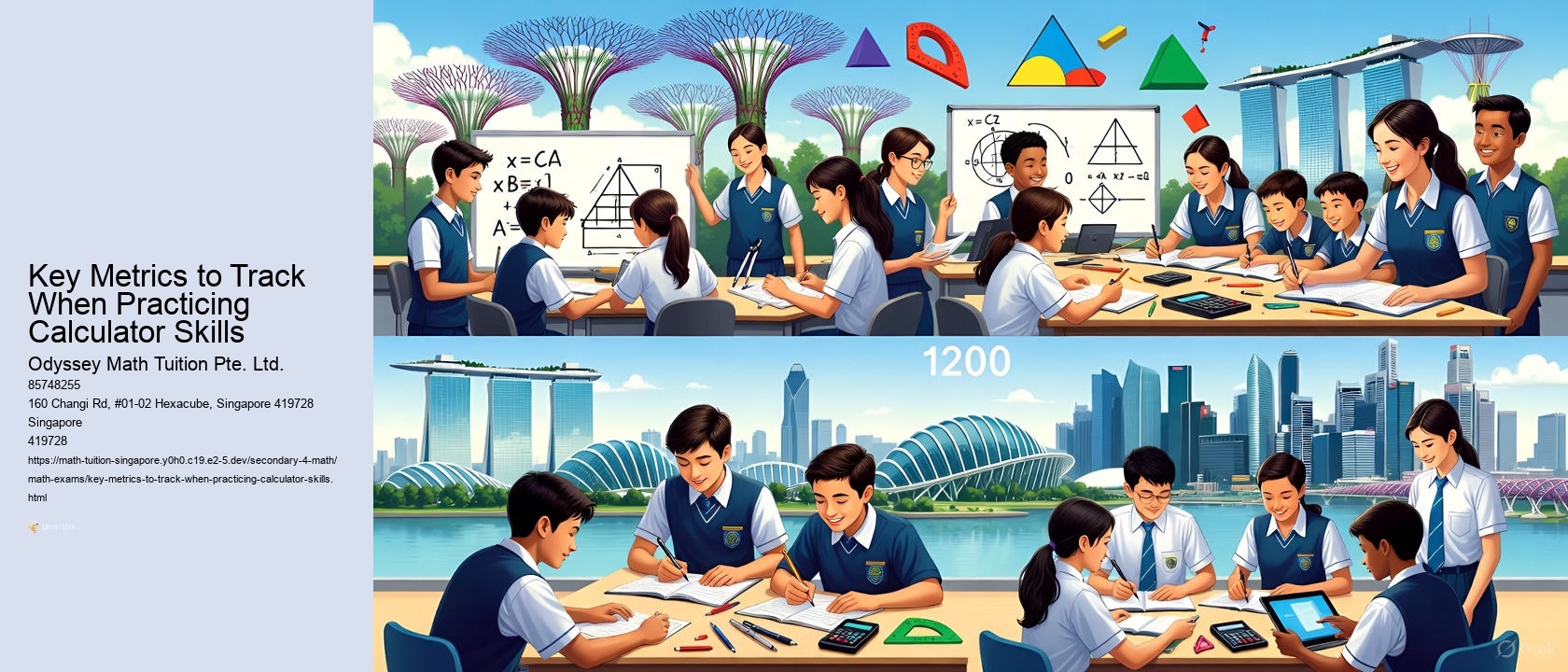
Alright, parents and Sec 4 students, leh! Let's talk about something crucial for acing those 'O' Level math exams: your trusty calculator. In Singapore's high-stakes education environment, knowing how to excel in Singapore Secondary 4 math isn't just about understanding the concepts; it's also about mastering the tools at your disposal. And that includes your calculator. Think of it as your mathematical sidekick, ready to help you conquer complex problems, save precious time, and ultimately, boost your scores. After all, every mark counts, right?
We all know how important mathematics is in Singapore. From engineering to finance, and now, even more so with the rise of AI, a solid foundation in math opens doors to countless future careers. In this age of algorithms and data analysis, understanding mathematical principles is no longer just an academic exercise; it's a fundamental skill for navigating the modern world. So, let's make sure you're equipped with every advantage possible!
So, you're practicing with your calculator. Good! But are you *really* practicing effectively? Here are some key metrics to keep an eye on, to make sure you're getting the most out of your study sessions and learn how to excel in Singapore Secondary 4 math:
* **Time per Problem:** This is a big one. Time is of the essence during exams. Use a stopwatch to track how long it takes you to solve different types of problems using your calculator. Aim to reduce this time consistently. Remember, every second saved is a second you can use to tackle another question or double-check your work. * **Accuracy Rate:** Speed is important, but accuracy is paramount. What's the point of solving a problem quickly if you get it wrong? Track the percentage of problems you solve correctly using your calculator. Identify areas where you consistently make mistakes and focus your practice there. * **Frequency of Errors:** Are you making the same types of mistakes repeatedly? Maybe you're consistently pressing the wrong buttons or misinterpreting the calculator's display. Identifying these patterns can help you break bad habits and improve your overall accuracy. * **Types of Problems Solved:** Are you only practicing the easy stuff? Be honest with yourself! Make sure you're tackling a variety of problem types, including those that you find challenging. This will help you build confidence and prepare you for anything the exam throws your way. * **Calculator Functions Used:** Are you only using the basic functions? Your calculator is a powerful tool with a wide range of capabilities. Explore and master functions like solving equations, statistical calculations, and matrix operations. The more functions you know, the more efficiently you can solve problems.
Fun Fact: Did you know that the first electronic calculator was the size of a room? Thankfully, yours fits neatly in your hand (and hopefully, is exam-approved!).
Knowing your calculator's functions is just the beginning. Here are some techniques and shortcuts that can help you solve problems even faster and more accurately, a crucial part of how to excel in Singapore Secondary 4 math:
* **Equation Solving:** Many calculators can solve equations directly. Learn how to use this function to quickly find the roots of quadratic, cubic, and other types of equations. This can save you valuable time compared to solving them manually. * **Statistical Calculations:** Master the statistical functions on your calculator, such as calculating mean, standard deviation, and correlation coefficients. These functions are essential for solving statistics problems quickly and accurately. In this nation's challenging education structure, parents fulfill a vital part in directing their kids through significant evaluations that shape educational futures, from the Primary School Leaving Examination (PSLE) which assesses basic abilities in disciplines like math and science, to the GCE O-Level assessments emphasizing on intermediate mastery in diverse disciplines. As pupils move forward, the GCE A-Level tests require more profound logical skills and topic mastery, frequently determining university admissions and occupational directions. To stay knowledgeable on all facets of these national exams, parents should check out official materials on Singapore test papers supplied by the Singapore Examinations and Assessment Board (SEAB). This secures access to the latest curricula, test calendars, registration details, and instructions that align with Ministry of Education standards. Frequently referring to SEAB can help households get ready effectively, reduce doubts, and support their children in reaching optimal performance in the midst of the challenging environment.. * **Matrix Operations:** If your syllabus includes matrices, learn how to perform matrix operations like addition, subtraction, multiplication, and finding determinants using your calculator. This can significantly simplify complex calculations. * **Memory Functions:** Use the memory functions on your calculator to store intermediate results and constants. This can help you avoid rounding errors and save time when performing multi-step calculations. * **Practice Makes Perfect:** The more you practice using these techniques and shortcuts, the faster and more efficient you'll become. Set aside dedicated time each week to practice calculator skills, and don't be afraid to experiment and try new things.
Don't underestimate the power of the memory buttons! Storing values in your calculator's memory (usually labeled A, B, C, D, etc.) can be a lifesaver when dealing with long calculations. Instead of re-entering the same number multiple times, simply recall it from memory. This reduces the risk of errors and saves precious seconds. Siao liao if you key in the wrong number halfway through a complicated equation, right?
Interesting Fact: The abacus, one of the earliest calculating tools, is still used in some parts of the world! It's a testament to the enduring power of calculation.
By focusing on these key metrics and mastering calculator techniques, you can transform your calculator from a simple tool into a powerful strategic asset. So, go forth, practice hard, and conquer those 'O' Level math exams! Remember, with the right skills and a bit of kiasu spirit, you can achieve anything!
Alright, parents and Sec 4 students, leh, let's talk about something crucial for acing your 'O' Level Math: Speed of Execution. In this era of lightning-fast AI, being quick on the draw with your calculator isn't just a good skill; it's practically a superpower!
Think about it: the 'O' Level Math exam isn't just about knowing the formulas; it's about applying them accurately *and* quickly. Every second counts, and mastering calculator techniques can give you that precious edge. It's not just about getting the answer; it's about getting it before the uncle next to you does! This is how to excel in Singapore Secondary 4 Math.
Why is speed so important? Well, beyond the obvious time crunch, speed builds confidence. The faster you solve problems, the less stressed you'll be, leaving you with more brainpower to tackle the trickier questions. And let's be honest, confidence is half the battle, right?
So, how do we turbocharge your calculator skills? Here are a few tips for Singapore parents and students:
Think of your calculator as your trusty sidekick, not just a button-pushing machine. Learning its hidden powers can seriously level up your game. Here are some essential techniques:
Instead of constantly re-entering values, use your calculator's memory functions (usually A, B, C, D, X, Y). Store intermediate results and recall them instantly. This is especially useful for complex calculations with recurring numbers. It's like having a mini-notebook inside your calculator!
Get familiar with Memory Recall (MR), Memory Clear (MC), Memory Plus (M+), and Memory Minus (M-). In a modern age where continuous education is crucial for professional advancement and individual improvement, top schools worldwide are eliminating barriers by providing a abundance of free online courses that cover diverse topics from informatics science and management to social sciences and medical fields. These programs permit learners of all backgrounds to utilize high-quality sessions, tasks, and materials without the monetary burden of traditional registration, frequently through systems that provide convenient pacing and interactive elements. Uncovering online universities free courses opens opportunities to prestigious schools' knowledge, enabling proactive individuals to improve at no charge and earn certificates that boost CVs. By providing elite instruction openly available online, such offerings foster worldwide fairness, empower disadvantaged populations, and foster innovation, proving that high-standard education is more and more just a click away for anyone with web connectivity.. These functions allow you to accumulate values and perform calculations on them without rewriting everything. Trust me, they're lifesavers when dealing with statistics or iterative processes.
Just like athletes train for a race, you need to train your calculator skills. Set a timer and work through practice problems, focusing on speed and accuracy. Track your progress and identify areas where you can improve. There are plenty of free resources online with Secondary 4 Math practice questions. Remember, practice makes perfect!
Fun fact: Did you know that early mechanical calculators were HUGE and required a lot of cranking? Thank goodness for modern technology, right? Imagine bringing *that* to your 'O' Levels!
By focusing on speed of execution and mastering these calculator techniques, you'll be well on your way to conquering your 'O' Level Math exam. Remember, every little bit helps, and with consistent effort, you can achieve your goals. Jia you! In Singapore's bilingual education system, where fluency in Chinese is essential for academic achievement, parents frequently seek approaches to help their children master the lingua franca's subtleties, from vocabulary and interpretation to composition writing and oral abilities. With exams like the PSLE and O-Levels imposing high benchmarks, timely intervention can prevent common pitfalls such as poor grammar or minimal access to heritage aspects that enhance knowledge acquisition. For families aiming to boost performance, delving into Singapore Chinese tuition resources offers knowledge into structured programs that match with the MOE syllabus and foster bilingual assurance. This focused support not only enhances exam readiness but also develops a greater appreciation for the language, paving doors to traditional heritage and future professional benefits in a pluralistic society.. (Add oil!)
In the high-stakes world of Singapore Secondary 4 Math, especially during crucial exams like the 'O' Levels and 'N' Levels, accuracy is paramount. Speed is fantastic, but what's the point of blazing through a problem if you get the answer wrong? Think of it like this: it's better to be steady and correct than fast and furious, ending up with a pile of mistakes that cost you valuable marks. After all, every mark counts towards your overall grade and future academic pathways. This is especially true with the increasing emphasis on STEM fields, where mathematical precision is non-negotiable.
One of the most common sources of errors is simply miskeying numbers into your calculator. Before you even hit that equals sign, take a split second to double-check what you've punched in. Did you accidentally add an extra zero? Did you transpose two digits? These seemingly small errors can lead to completely wrong answers. Make it a habit to glance at the display and confirm that it matches the values in the problem. In the Lion City's rigorous education environment, where English serves as the main channel of teaching and plays a pivotal position in national tests, parents are keen to assist their children tackle frequent hurdles like grammar influenced by Singlish, word deficiencies, and issues in understanding or essay creation. Developing robust basic skills from early grades can substantially enhance confidence in handling PSLE components such as contextual authoring and spoken communication, while upper-level students gain from specific practice in literary analysis and persuasive compositions for O-Levels. For those looking for efficient methods, investigating singapore math tuition agencies offers useful information into courses that sync with the MOE syllabus and emphasize interactive instruction. This extra assistance not only refines exam techniques through mock exams and feedback but also supports domestic habits like regular reading and conversations to foster long-term language proficiency and scholastic success.. Prevention is always better than cure, especially when time is ticking away during an exam. This simple act can significantly improve your accuracy rate, ah!
Remember BODMAS (Brackets, Orders, Division, Multiplication, Addition, Subtraction)? Your trusty calculator follows this order of operations implicitly, but you need to be mindful of how you input complex expressions. If you're not careful with brackets, you might end up performing operations in the wrong sequence, leading to incorrect results. Always break down complex calculations into smaller, manageable steps, using brackets to ensure that the calculator performs the operations in the intended order. Understanding this will help you how to excel in singapore secondary 4 math. This is especially crucial when dealing with algebraic expressions or statistical calculations.
Develop a systematic approach to problem-solving. Before reaching for your calculator, take a moment to understand the problem, identify the relevant formulas, and plan your steps. Write down the key values and the steps you'll take to solve the problem. This not only helps you stay organized but also makes it easier to spot potential errors along the way. Think of it as creating a roadmap for your calculation, guiding you towards the correct solution. A clear and structured approach is crucial for improving accuracy and building confidence in your mathematical abilities.
Careless mistakes are the bane of every student's existence. They're often the result of rushing, stress, or simply not paying close attention. To combat this, practice mindfulness during your calculations. Focus on each step, double-check your inputs, and be aware of potential pitfalls. Take short breaks during long practice sessions to avoid mental fatigue. Remember, a calm and focused mind is less prone to errors. Implement these strategies diligently, and you'll see a significant improvement in your accuracy rate, paving the way for success in your Secondary 4 Math exams and beyond. In the Lion City's dynamic education environment, where students deal with significant pressure to excel in numerical studies from elementary to tertiary levels, finding a educational centre that merges knowledge with genuine zeal can bring significant changes in fostering a passion for the discipline. Dedicated instructors who go beyond rote memorization to encourage strategic reasoning and tackling competencies are uncommon, however they are vital for helping students surmount obstacles in topics like algebra, calculus, and statistics. For parents hunting for such dedicated assistance, PSLE math tuition stand out as a example of commitment, driven by teachers who are profoundly invested in individual pupil's progress. This steadfast dedication converts into personalized teaching plans that modify to unique needs, resulting in improved grades and a lasting respect for math that spans into future educational and professional pursuits..
Right, Secondary 4 parents and students, listen up! In Singapore, acing your 'O' Levels, especially math, is like securing your golden ticket to a brighter future. And let's be real, in this AI-driven world, math isn't just about memorizing formulas; it's about building the logical thinking skills that will set you apart. So, how lah do we make sure you're not just passing, but slaying that math exam? Let's dive into the secret weapon you've probably been overlooking: your trusty calculator!
Think of your calculator as your kaki (buddy) in the exam hall. But having it isn't enough; you need to know how to wield it like a pro. This isn't just about adding and subtracting, okay? We're talking about mastering the functions that can save you precious minutes and boost your accuracy.
Key Functions to Master:
How to Become a Calculator Ninja:
Tuition Tips for Leveraging Calculator Functions Effectively:
Fun Fact: Did you know that the first electronic calculator was the size of a room? Thankfully, yours fits neatly in your pencil case!
Beyond the basic functions, there are often hidden techniques and shortcuts that can give you an edge.
Where applicable, add subtopics like:
Interesting Fact: The abacus, one of the earliest calculating tools, is still used in some parts of the world today! Talk about a classic!
How to Excel in Singapore Secondary 4 Math:
Mastering these calculator skills is just one piece of the puzzle. Here are a few more tips to help you ace your 'O' Level math exam:
Remember, Secondary 4 is a crucial year, but it's also an opportunity to build a strong foundation for your future. By mastering your calculator skills and following these tips, you'll be well on your way to achieving your goals. In Singapore's highly challenging academic setting, parents are devoted to supporting their youngsters' excellence in essential math assessments, beginning with the basic obstacles of PSLE where problem-solving and abstract grasp are tested thoroughly. As students move forward to O Levels, they face further intricate topics like geometric geometry and trigonometry that necessitate exactness and critical abilities, while A Levels present advanced calculus and statistics requiring profound understanding and implementation. For those resolved to offering their offspring an scholastic advantage, locating the tuition adapted to these programs can transform instructional processes through focused strategies and professional insights. This investment not only elevates test performance over all tiers but also instills enduring mathematical mastery, creating opportunities to renowned schools and STEM professions in a knowledge-driven society.. Jiayou (add oil)!
Monitor how quickly and accurately you solve problems. Track the time taken per question and the number of correct answers. This helps identify areas where you need to improve your speed without sacrificing accuracy, crucial for time-constrained exams.
Assess your expertise in using various calculator functions. Keep a record of the different functions you've mastered (e.g., solving equations, statistics). Regular tracking ensures you're fully utilizing the calculator's capabilities to enhance problem-solving efficiency.
Keep a detailed log of the types of errors you make while practicing. Note whether errors stem from incorrect calculator inputs or misunderstanding the question. Analyzing these patterns helps refine your technique and minimize mistakes under pressure.
Okay, lah, parents and students! Let's talk about how to really ace that Secondary 4 Math exam. It's not just about mugging, it's about working smart, especially with your trusty calculator. In this digital age, with AI breathing down our necks, mastering these techniques is super important – it's your secret weapon, your "kiasu" edge! This is how to excel in singapore secondary 4 math!
In the Lion City's high-stakes academic scene, parents dedicated to their children's achievement in mathematics often prioritize understanding the systematic advancement from PSLE's foundational analytical thinking to O Levels' detailed topics like algebra and geometry, and additionally to A Levels' higher-level concepts in calculus and statistics. Staying aware about syllabus revisions and exam standards is essential to offering the appropriate assistance at all phase, making sure learners build confidence and attain top results. For authoritative perspectives and resources, checking out the Ministry Of Education - MOE page can deliver useful updates on regulations, programs, and educational approaches tailored to local standards. Engaging with these reliable materials enables parents to match home education with school standards, nurturing lasting success in numerical fields and more, while keeping informed of the newest MOE initiatives for holistic pupil development..Forget slogging through every problem the long way. The key to conquering Secondary 4 Math – and scoring those sweet, sweet distinctions – lies in spotting opportunities to deploy calculator shortcuts. We're talking about transforming your calculator from a simple number cruncher into a strategic problem-solving tool.
Calculator Techniques and Shortcuts
Here's the deal: your calculator is more powerful than you think. It's not just for basic arithmetic; it's got features that can save you precious time and effort during exams.
SOLVE Function: Your Equation-Solving BFF
Got a complicated equation giving you headaches? The SOLVE function is your answer. Instead of spending ages manipulating variables and potentially making mistakes, just input the equation and let your calculator do the heavy lifting.
Stats Mode: Data Processing Powerhouse
Statistics questions feeling like a mountain? The stats mode is your Sherpa. Input your data, and your calculator can instantly calculate mean, standard deviation, and other essential statistical measures. No more tedious manual calculations!
Advanced Techniques: Unlock the Full Potential
Explore advanced functions like matrix operations (especially useful for linear algebra) and complex number calculations. These can drastically simplify certain problem types.
Spotting the Opportunities:
Fun Fact: Did you know that the first electronic calculator was the size of a room? Now, we have powerful calculators that fit in our pockets! Talk about progress, right?
Where to Apply These Shortcuts:
Interesting Fact: The use of calculators in education has been a topic of debate for decades. Some argue they hinder understanding, while others, like us, believe they can enhance problem-solving skills when used strategically.
Calculator Techniques and Shortcuts
Subtopic: Mastering the Memory Functions
Subtopic Description: Explore how M+, M-, MR, and MC functions can store and recall intermediate calculations, reducing errors and saving time in multi-step problems.
By mastering these calculator techniques, you're not just learning how to excel in singapore secondary 4 math; you're equipping yourself with essential skills for future studies and careers. Remember, mathematics is the language of the future, especially with AI becoming increasingly prevalent. Knowing how to wield your calculator effectively will give you a significant advantage. So, go forth and conquer those exams, Singapore! You can do it!
Right, Secondary 4 parents and students, listen up! We know the pressure is on to score in those 'O' Level exams. Every second counts, especially in Math. And let's be real, Math is the foundation, the kiasu (Singaporean for 'afraid to lose') subject that opens doors to everything – from engineering to finance, and even navigating the rise of AI. You think AI is magic? In recent times, artificial intelligence has revolutionized the education field internationally by allowing personalized learning experiences through responsive systems that tailor material to individual student speeds and approaches, while also streamlining assessment and operational responsibilities to liberate instructors for deeper impactful engagements. Internationally, AI-driven systems are overcoming learning gaps in underprivileged regions, such as utilizing chatbots for language learning in developing nations or forecasting insights to detect at-risk students in European countries and North America. As the adoption of AI education builds traction, Singapore stands out with its Smart Nation project, where AI tools boost program tailoring and accessible education for multiple requirements, covering special education. This strategy not only elevates exam outcomes and participation in regional institutions but also aligns with worldwide endeavors to nurture ongoing skill-building competencies, readying learners for a technology-fueled society amongst moral considerations like privacy privacy and fair access.. Nah, it's all Math underneath the hood! So, let's talk about how to really maximise your calculator skills. This isn't just about pressing buttons; it's about strategic time-saving, leh!
Think of your calculator as your personal cheongsam (weapon) in the exam hall. But a cheongsam is only useful if you know how to wield it effectively, right? That's where tracking your time savings comes in.
Here's the deal:
Fun Fact: Did you know that the first mechanical calculators were invented in the 17th century? Blaise Pascal, the famous mathematician, created one at the age of 19 to help his father with tax calculations! Imagine how much time he could have saved with a modern scientific calculator!
Okay, so you know why you need to track time savings. Now, let's talk about how to actually save that time. This is where those calculator techniques and shortcuts come in.
Subtopic: Mastering the Memory Function
Subtopic: Programming Simple Formulas

Interesting Fact: The first electronic calculator was the size of a room! Now, we carry them in our pockets. Talk about progress, hor?
Look, Singapore is all about the future, and the future is definitely about AI. But AI isn't some magical black box. It's built on Math. The more you understand Math, the better you'll be able to understand and use AI.
So, mastering your calculator skills isn't just about getting a good grade on your 'O' Levels. It's about building a foundation for a successful career in a world that's increasingly driven by technology. It's about giving yourself the competitive edge in Singapore's fast-paced, kiasu environment.
How to excel in Singapore Secondary 4 Math? Practice, track your progress, and embrace the power of your calculator. Don't just memorise formulas; understand the concepts. And remember, every second you save on a question is a second you can use to tackle a tougher problem or double-check your work. Can or not? Confirm can!
Related Keywords: Secondary 4 Math Tuition, 'O' Level Math Tips, Singapore Math Exam Strategies, Calculator Techniques for Math, Singapore Education System.
Alright, parents and Sec 4 students, listen up! We know the pressure is on to ace those exams. And let's be real, in Singapore, doing well in school, especially in Math, is like having a golden ticket. It opens doors, lah! So, how ah? Let's talk about consistent practice and continuous improvement, especially when it comes to your trusty calculator.
Think of your calculator as your kaki (friend) in the exam hall. But even the best kaki needs some training! Here's what to keep an eye on as you hone your calculator skills:
Speaking of exams, did you know that the first calculators were huge, room-sized machines? Imagine lugging that into the exam hall! Thankfully, technology has shrunk them down to pocket-sized powerhouses.
Knowing how to use your calculator is important, but knowing tricks? That's next-level stuff! Here are some calculator techniques and shortcuts to help you excel in Singapore Secondary 4 Math:
Memory Functions: Utilize the memory functions to store intermediate results and constants. This can prevent rounding errors and save you time.
So, where do you find the materials to put all this into practice?
Remember, kiasu (fear of losing out) is part of the Singaporean DNA, but don't let it overwhelm you. Consistent practice, a positive attitude, and a well-trained calculator are your best weapons for conquering those exams. And hey, with AI becoming more and more prevalent, a strong foundation in math will set you up for success in whatever career you choose. Jiayou! (Add oil!)
Tracking metrics helps identify areas of weakness, measure progress, and optimize study strategies for improved calculator proficiency and exam performance.
Key metrics include speed (time per question), accuracy (percentage of correct answers), types of errors made, and the specific functions or operations causing difficulty.
Use a timer to record the time taken to solve each question. Calculate the average time per question to track your speed improvement over time.
Accuracy indicates how well you understand the concepts and your proficiency in using the calculator correctly. A low accuracy rate suggests reviewing the relevant topics and calculator functions.
Track errors like incorrect button presses, wrong formula application, or misinterpreting the question. This helps pinpoint specific areas for improvement and prevents repeating the same mistakes.
By identifying and addressing specific weaknesses in calculator usage, your child can become more efficient and accurate, leading to improved performance and higher scores on their exams.